The Ferret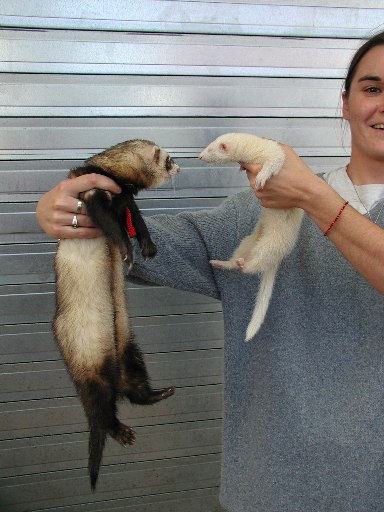
The ferret is the domestic form of the European polecat, a domestication going back more than 2,000 years. It was used to destroy rats and snakes, and then to hunt rabbits.
By turns a travelling companion of sailors, a laboratory animal and raised for its fur, it is today increasingly popular as a pet in the United States (> 7 million individuals) and in Europe.
Diet:
The ferret is a strict carnivore. Because of their fast metabolism, ferrets like to eat many small meals, so they must always have water and food available. In the absence of ferret food, which is not always available, one should feed it high-quality kitten food. Adult cat food does not contain enough protein (it should contain between 36 and 38%, and 22 to 24% fat). It is important to vary the brands of kibble, in order to avoid becoming accustomed to a particular brand, which would then cause the ferret problems if it later had to be changed.
Wet pouches can be eaten, as can fruit, meat/eggs or special treats, while remaining occasional.
Living environment:
A ferret socialised from a very young age will be a delightful companion. It can live perfectly well indoors or outdoors (beware of heatstroke!). It is preferable to keep it in a spacious cage (min. 2 m²) while you are away. Clean by nature, it always relieves itself in a set spot in the cage if it has been trained that way. Some “little accidents” are possible, especially when it is free to roam. The litter must be changed daily. Beware of rubber, erasers, sponges, plastic or toxic products; it can sometimes swallow just about anything! And beware of trauma (falls, do not sit on the cushion under which it is napping, mind the doors, the toilet, etc.)
Care:
It does no harm to give them a bath from time to time, at most once a month with a suitable shampoo.
The claws should be trimmed regularly, about every 4 weeks.
If it is fairly cooperative, you can clean its ears, which get dirty very quickly; otherwise ask your veterinarian for advice.
An annual vaccination is strongly recommended, which protects against canine distemper, similar to that of the dog. Neutering is strongly recommended to reduce its body odour, and spaying is compulsory in the non-breeding female to prevent a fatal aplastic anaemia. Removal of the anal glands is prohibited in Switzerland!
For crossing borders, being considered a carnivore, it must be protected against rabies and must be fitted with a microchip.
Common diseases
The ferret is prone to a few characteristic diseases: the adrenal gland disease, theinsulinoma (a tumour of the pancreas) and lymphoma. It also catches our flu and readily swallows small objects.
Adrenal gland disease. Common in the middle-aged ferret, it comes from small glands (the adrenals) that produce too many hormones. Characteristic sign: hair loss that starts at the tail and then spreads to the flanks, often with itching; in the female, the vulva may swell. This can be treated (medication or surgery).
Insulinoma. A small tumour of the pancreas that produces too much insulin: the level of sugar in the blood falls. The ferret becomes weak, drools, has a fixed or “absent” stare, or even trembles, especially if it has not eaten for a while.
Other points. Lymphoma (a cancer affecting the immune system) is among the diseases known in the ferret. The ferret catches our flu — and can pass it on to us. As it readily swallows rubber, foam or plastic, an object stuck in the intestine (obstruction) is a real risk.
When to see a vet promptly Unusual hair loss (tail, flanks), weakness or a lasting drop in appetite.
When to see a vet urgently Loss of consciousness or trembling (a drop in blood sugar), repeated vomiting, a stoppage of feeding or great weakness. If it becomes faint, rub a little honey or syrup on its gums and call immediately.
Key points Watch the coat (adrenal glands), vigour and appetite (insulinoma, obstruction). This information does not replace a consultation.